Skip to content
Seven Medicine

How it works · AcuGraph digital meridian scan

A visual baseline — and a way to look back at where you started

At your first visit, Dr. Kristina records an AcuGraph scan: a few minutes of skin-conductance readings at acupuncture points. It gives us one more data point to compare against later. It complements clinical evaluation. It isn't a diagnosis, and it isn't proof of anything on its own.

What it is

Skin-conductance readings, organized by meridian

AcuGraph (by Miridia Technology) uses a handheld probe to measure the skin’s electrical conductance at 24 traditional acupuncture “source” points on the wrists and ankles — the twelve meridians, left and right.

The software compares each reading to your own average and to the opposite side, then displays the results as a color-coded graph. Dr. Kristina uses it, alongside your history and her clinical assessment, to inform point selection and to track changes over time.

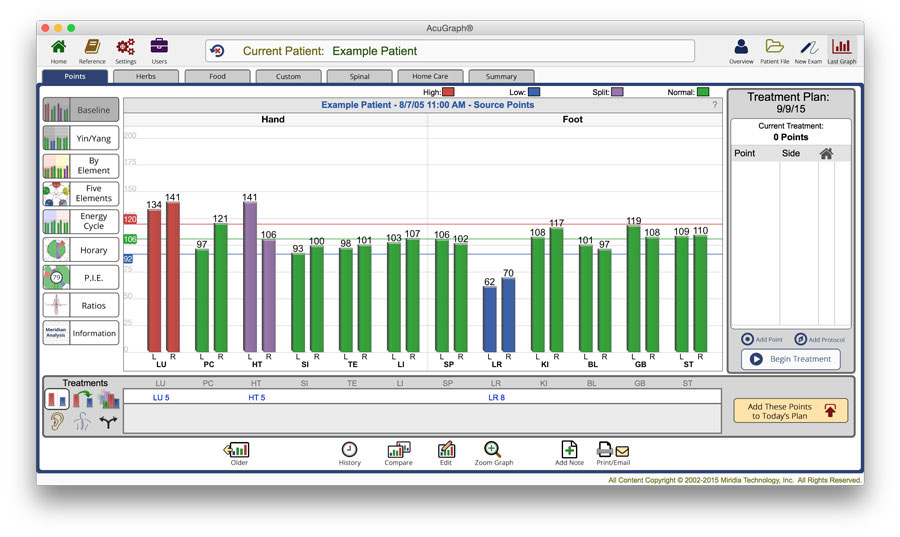
AcuGraph baseline screen (software example patient): paired left/right bars for twelve meridians, color-coded high, low, split and normal
Sample AcuGraph screen (manufacturer example patient, not Seven Medicine patient data). Bars show relative readings per meridian, left and right.

How it works

What happens during a scan

  1. 01

    Settle in

    You sit or lie comfortably for a few minutes. Hands and feet should be clean and dry, free of lotion.

  2. 02

    Point readings

    Dr. Kristina touches the probe briefly to each of the 24 points. You'll feel light pressure — nothing more.

  3. 03

    See the graph

    The software displays your readings by meridian, relative to your own average and left/right balance.

  4. 04

    Talk it through

    Dr. Kristina explains what she notices, how it relates (or doesn't) to your symptoms, and what she'll factor into treatment.

Video

An introduction to AcuGraph

A short patient-education video from AcuGraph's manufacturer. Where it describes what the scan reveals, remember our framing: it's a supportive data point, not a diagnosis.
Video © Miridia Technology, provided to AcuGraph clinics for patient education.

Your first and follow-up scans

Your first scan

Establishing a baseline

Your first scan happens during your Initial Consultation. Combined with your symptoms, history and TCM assessment, it gives a recorded starting point — something more concrete than memory to compare with later. Some patients find it a helpful way to visualize what Dr. Kristina is describing.

Your follow-up scan

Reassessing after about a month

Dr. Kristina may repeat the scan around the first formal reassessment — often about a month into care, depending on your treatment plan. The follow-up scan can be compared side by side with your baseline. We review it together with what matters most — how your symptoms, sleep, cycle, energy or pain have actually changed — and adjust your plan accordingly.

What the AcuGraph software shows

The same reading can be viewed several ways. Dr. Kristina reviews these alongside your symptoms and TCM assessment, then compares them with your follow-up reading around your first formal reassessment.

AcuGraph baseline graph: paired left/right bars for twelve meridians at hand and foot points, color-coded high, low, split and normal
AcuGraph software screens (Miridia Technology), shown with the program’s example patient.

What we look at

Patterns and changes over time

  • Relative highs and lows across meridians
  • Left/right differences (‘splits’)
  • Overall patterns, considered alongside your TCM assessment
  • How readings compare between your baseline and follow-up scans

Limitations, plainly stated

What AcuGraph is not

  • Not a diagnostic test. It doesn’t diagnose, screen for or rule out any disease, and it doesn’t replace labs, imaging or your physician’s evaluation.
  • Not proof that acupuncture works. A change in readings is not, by itself, evidence of clinical improvement. Your symptoms and function are what count.
  • Sensitive to conditions. Studies show skin conductance varies with age, sex, time of day and operator technique, and research has not established that acupuncture points are electrically distinct. We interpret readings cautiously.
  • Regulatory status. The device is listed with the FDA as an acupuncture point locator; it is not FDA-cleared or approved as a diagnostic device.

Selected references: Mist SD et al., Acupunct Med 2011 (PMID 21602233); Chamberlin S et al., J Acupunct Meridian Stud 2011 (PMID 21440876); Ahn AC et al., Bioelectromagnetics 2008 (PMID 18240287).

FAQ

AcuGraph questions

Does AcuGraph diagnose disease?

No. It measures skin conductance at acupuncture points. It isn't a diagnostic test and doesn't replace labs, imaging or your doctor's evaluation.

Does a better scan prove acupuncture worked?

No. Scan readings can change for many reasons, including time of day and hydration. What matters most is how your symptoms and daily life are changing — the scan is one extra reference point.

How often are scans repeated?

Usually once at your first consultation. Dr. Kristina may repeat the scan around the first formal reassessment — often about a month into care, depending on your treatment plan.

What does the scan feel like?

A small probe touches points on your wrists and ankles for a moment. You'll feel light pressure — nothing more. It takes a few minutes.

View all FAQs

Still have questions?

or call(507) 258-7771

Initial consultation · 30 minutes

Get your baseline at your first visit.

Your first visit is a 30-minute consultation with Dr. Kristina Gacesa: your history, a TCM assessment, an AcuGraph baseline and a personalized recommendation with exact pricing. No treatment plan is required to book.

$49.99

Introductory rate · normally $249.99 · through Dec 31, 2026

If you continue: $159.99/visit, or $129.99/visit on a treatment plan.

Book initial consultation (opens in a new tab)

Have a question first? or call (507) 258-7771

CallBook consultation (opens in a new tab)